Sizing a PV system for two homes with a solar cloud - Part 1
At my parents’ place, we had been thinking for a while about installing solar panels. The goal was clear:
- Reduce the electricity bill.
- Take advantage of the available solar radiation.
- Have a simple, stable system with a reasonable payback.
In this post I’ll share the full process, from sizing to choosing tariffs, as a practical guide if you want to do something similar.
1) Sizing (the most important part)
Before buying anything, I focused on two things: solar radiation and real consumption.
1.1 Radiation: the European calculator (PVGIS)
To estimate how much energy the roof could produce, I used the EU tool PVGIS (Photovoltaic Geographical Information System):
https://re.jrc.ec.europa.eu/pvg_tools/en/tools.html
With PVGIS you can get:
- Estimated annual production (kWh/year)
- Monthly production (very useful to see seasonality)
- Impact of orientation and tilt
- Estimated losses (temperature, wiring, inverter, etc.)
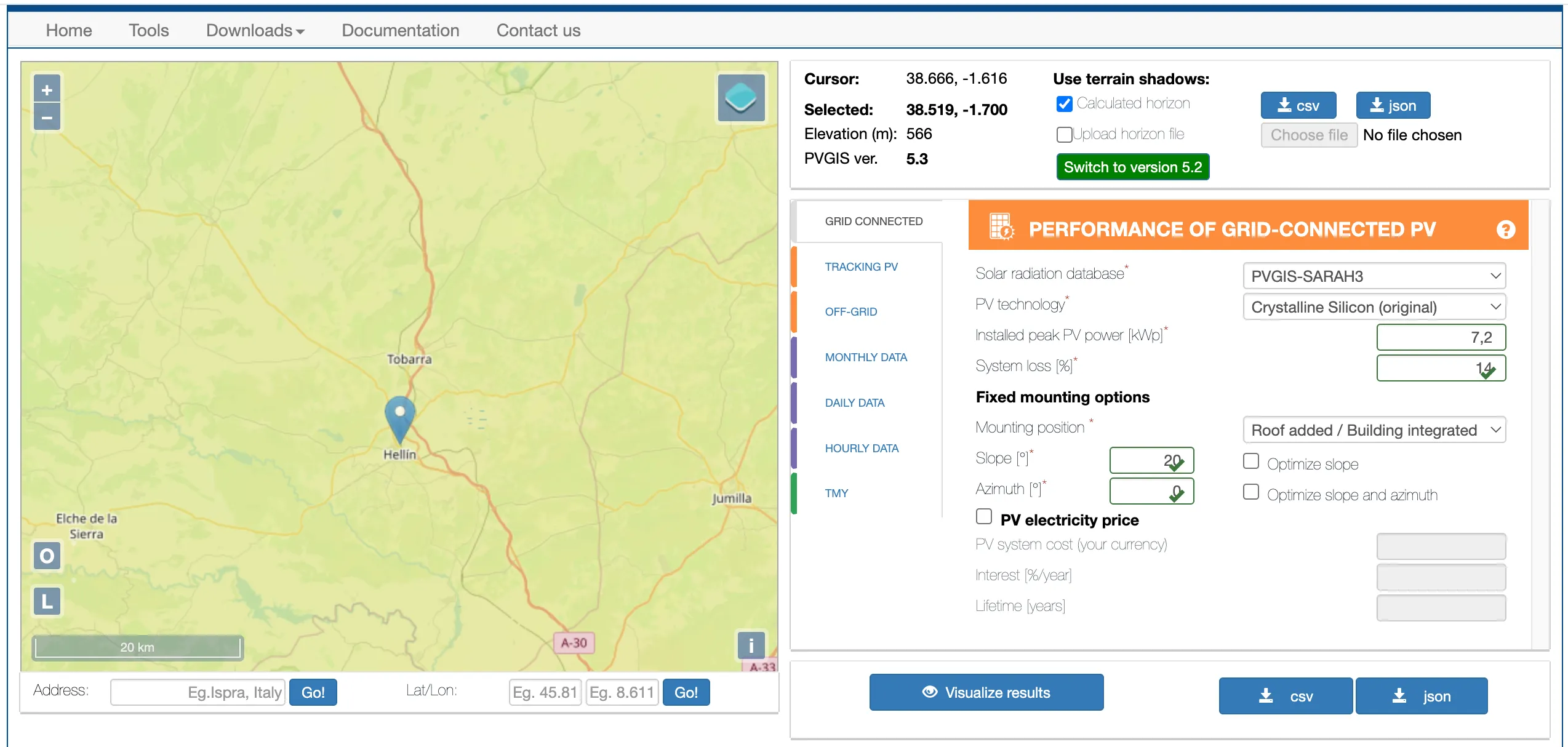
What I entered in the calculator:
- Exact location (coordinates or approximate address)
- Estimated system power (kWp)
- Roof orientation (azimuth)
- Tilt angle (degrees)
- Losses (a reasonable % if you don’t have it fine-tuned)
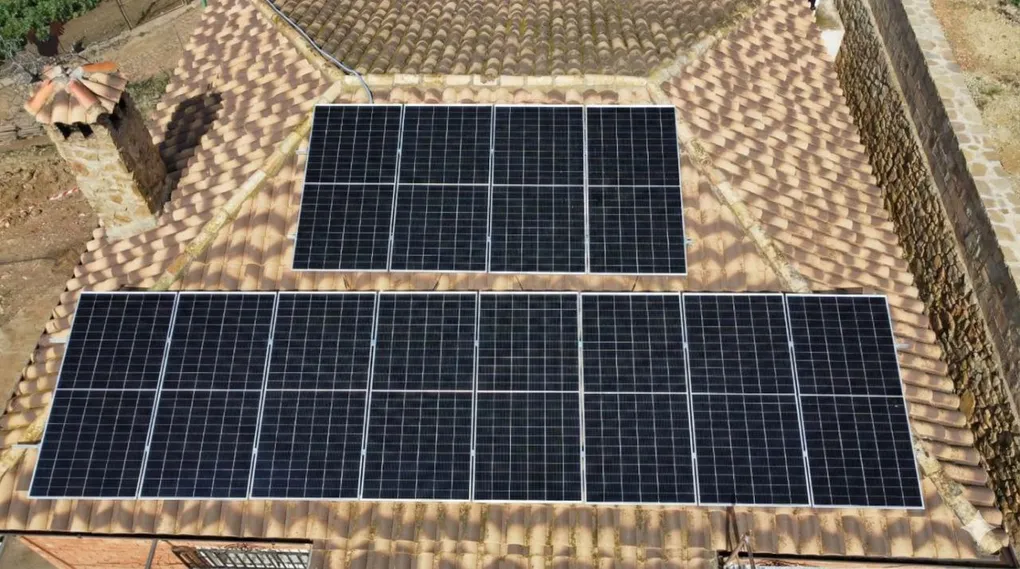
In our case, the house is south-facing and, based on the roof size, it can fit 12 panels of around 600 W each. That gives 7.2 kWp. Later we’ll see how many panels the inverter supports and how to match everything in the final design.
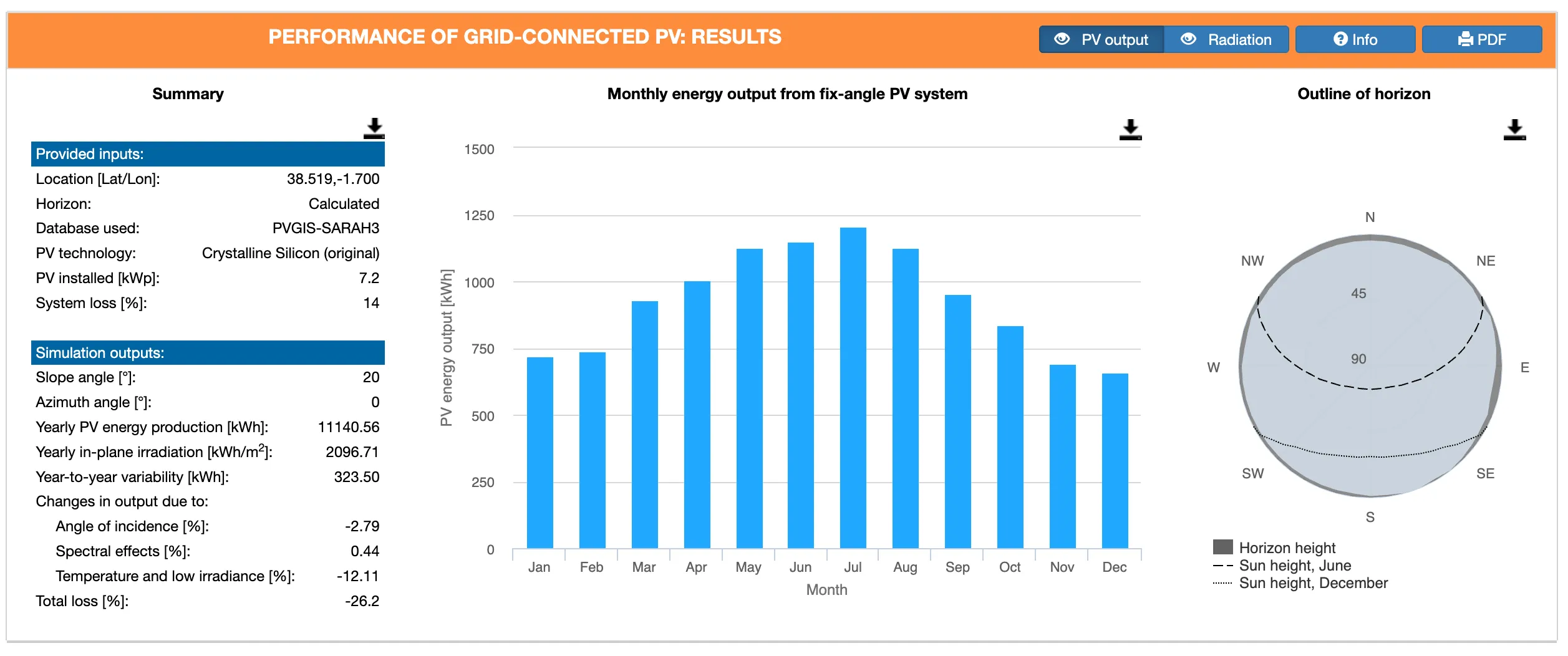
The key point: PVGIS gives you a realistic baseline so you don’t have to guess.
Tip: I didn’t size only based on annual production, but on how production matches consumption (especially during solar hours).
2) Problem setup
My parents have two homes:
- Country house (used mainly in summer): this is where the PV system will be installed.
- City house (used all year round): electricity consumption is more stable.
The idea is to install a single PV plant at the country house and use it like this:
- Direct self-consumption at the country house (fridges, base loads, etc.).
- Any surplus is exported to the grid and converted into credit in a solar cloud (similar to a “virtual battery”):
- Each exported kWh is paid at €0.07/kWh
- The credit accumulates month after month (no expiration)
- The city house pays part of its consumption using that credit
3) Estimated consumption (kWh/month) for each home
To size properly, the first step is to work in kWh, not euros.
Country house (where the PV is installed)
Base consumption (fridges, standby loads, and battery charging) follows this pattern:
- 180 kWh/month for 8 months
- 450 kWh/month for 4 months
Annual consumption:
- 180 × 8 = 1,440 kWh/year
- 450 × 4 = 1,800 kWh/year
Total country house = 3,240 kWh/year
City house (used all year round)
Here the pattern is the opposite:
- 450 kWh/month for 8 months
- 180 kWh/month for 4 months
Annual consumption:
- 450 × 8 = 3,600 kWh/year
- 180 × 4 = 720 kWh/year
Total city house = 4,320 kWh/year
Combined total consumption
Total consumption for both homes:
3,240 + 4,320 = 7,560 kWh/year
4) Proposed system
The proposed installation is:
- 7,200 Wp (7.2 kWp) of panels
- 6 kW inverter
- 5 kWh battery at the country house
The battery helps increase self-consumption at the country house (shifting nighttime usage to solar hours), but it doesn’t change the total annual energy produced—it only changes how that energy is distributed.
5) Estimated production with PVGIS
To estimate annual production, I used PVGIS with the configuration above.
Approximate annual result:
PV production = 11,435.5 kWh/year
This gives a first clear picture:
- PV production: 11,435.5 kWh/year
- Total consumption (2 homes): 7,560 kWh/year
The system produces more energy than both homes consume in a year.
6) Matching production vs consumption: self-consumption and surplus
Since the PV system is installed at the country house, it first covers that home’s consumption.
Estimated self-consumption at the country house
Annual self-consumption:
3,240 kWh/year
Annual exported surplus
The rest of the production is exported:
- Surplus = Production − Country house self-consumption
- Surplus = 11,435.5 − 3,240
- Surplus = 8,195.5 kWh/year
This surplus is what gets converted into credit in the solar cloud.
7) The solar cloud has an implicit “toll”
This is the key difference between normal self-consumption and sharing solar value between two homes.
At the city house, each consumed kWh costs approximately:
€0.15/kWh
But the country house surplus is paid at:
€0.07/kWh
That means that even though solar energy is “free” once installed, when it goes through the solar cloud it loses value.
Quick example (no formulas needed)
- If I consume 1 kWh at the city house, it costs €0.15
- To pay that 1 kWh using the solar cloud, I need exported surplus worth €0.15
- But each exported kWh is only worth €0.07
So I need to export:
- 0.15 / 0.07 = 2.14 kWh
In other words: to “pay for” 1 kWh at the city house, I need to export about 2.14 kWh from the country house.
That factor (~2.14×) is the system’s implicit toll: energy doesn’t travel as kWh, it travels as euros—and it gets devalued.
8) Annual value of the surplus (solar cloud)
With the estimated surplus:
Surplus = 8,195.5 kWh/year
The annual solar cloud credit would be:
- 8,195.5 × 0.07 = €573.7/year
Solar cloud credit generated ≈ €574/year
If the city house pays ~€0.15/kWh, that credit is roughly equivalent to:
- 573.7 / 0.15 = 3,824 kWh/year
So, with the annual surplus, the city house could cover around ~3,800 kWh/year of its energy consumption, assuming the credit is applied correctly.
And since the city house consumes:
4,320 kWh/year
That means it could almost cover the annual energy part, but not 100%.
9) Sizing conclusion
With these numbers, the conclusion is:
- The country house is largely covered by self-consumption (and the battery).
- The system produces a lot of surplus (~8.2 MWh/year).
- That surplus becomes ~€574/year to pay part of the city house consumption.
The key takeaway is:
- Self-consuming at the country house saves kWh at the “expensive” price (~€0.15/kWh).
- Exporting to use it at the city house means selling cheap (€0.07/kWh) and later buying expensive (~€0.15/kWh).
That’s why, even if the system is oversized in terms of production, part of the energy loses value through the solar cloud, as if there were a toll.
Still, if the installation cost is good, it can remain a profitable strategy: the PV system not only covers direct consumption, it also generates a stable annual credit that reduces the electricity bill of the second home.